My father has been dead for over twenty-five years. Most of those who knew him when he was young, in his prime, or even as an older man are dead. I want to know if there are any left who knew my father, any lucid ninety-eight-year-old with time to reminisce. I want to interview the veterans of the factories, the very old retirees who built the town where I grew up, just to hear their stories about him. My mother once told me that after my father’s death she met an old acquaintance in the grocery store who offered his condolences and then said, “Angelo. He was tough,” in a half-admiring, half-wistful tone. Why did he say that, I wondered, and what was he remembering? What was tough about my father? Was he easy to talk to? Was my father fun? Or funny?
When he died, the funeral home asked me to write the obituary they would submit to the newspapers of our choice. It was one of the many tasks grieving families must attend to between the death and the funeral, that strange span of days when you look at coffins, select remembrance cards, and go on odd shopping trips (sandwich platters, new socks for the deceased). I sat down in the kitchen to fill out the funeral home’s form. He was born and lived and died in the same town. He worked at the same manufacturing company for 42 years. He had been retired for ten. He belonged to St. Peter’s Church and The Sullivan Senior Center. Other than those memberships, he did not belong to any club, fraternal order, or military post. He had no significant, life-defining hobbies, like fishing or gardening. He had won no awards, had led no organizations, had not held public office. His legacy: “in addition to his wife, Nina, and his sister, Josephine, he leaves his son, John (Marie) and his daughter, Barbara (David).”
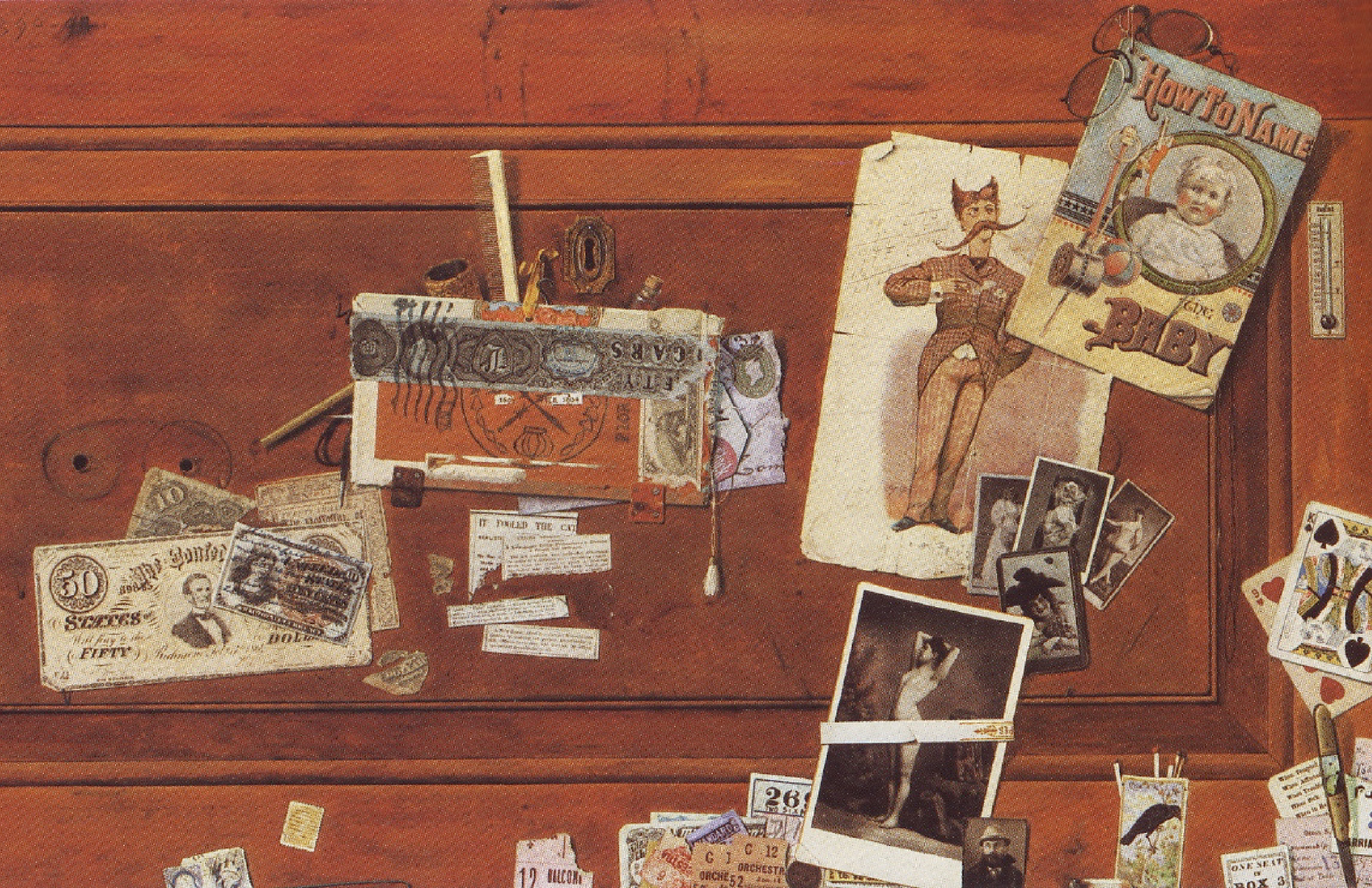
But the obituary was only one narrative, the popular kind that accounts for a life through deeds and affiliations. I got up from the kitchen table and went to look through his drawer, the one to the right of the kitchen sink, where he kept his papers and notes and pens and batteries for thirty-two years—and found an assortment of objects that were his essence. None were heirlooms or costly. None meant anything to anyone outside his family, and in time would lose their significance to us as well. But the layers of his ephemera were the story of him I knew well. Paper maps of Connecticut, New York, and Massachusetts. Promotional pens, with names of local businesses and politicians on them. Measuring tapes. Small notebooks with pages of tiny writing, logs for lawn mower and snow blower repair—“June 15—oil. July 1—sharpened blade.” Packs of peppermint Equal gum, which he had chewed after giving up his pipe. Root-beer-flavored hard candies, wrapped in translucent red paper. Small union lapel pins. What did I think I would find? Notes of his thoughts or musings? Birthday cards from me? Those were kept in the bedroom bureau drawers along with all the photos he took and all the postcards I had ever sent them.
He left an onyx signet ring, which went to my brother; an ordinary wristwatch, which went to me; and a gold watch his mother had given him that did not work, which my mother kept, along with his leather wallet, containing $40 in ones, fives, and a solitary ten. His clothes, his suits, all hung straight and neat in the closet. His church hat, long unused, was still perfectly boxed on the top closet shelf. His yard boots were by the back door. The tall bureau drawers were filled with long underwear, thick socks, and carefully pressed undershirts, the handiwork of my mother, who had succeeded in keeping him mended and ironed throughout his life. We had deliberated his burial suit earlier in the day—pinstriped or plain gray? He had choices. My mother’s habit of sacrifice meant that she did not attend to herself, as much as she loved clothes. She also hated black and did not own a single piece of black clothing. Buying suitable clothes for her became another pre-funeral errand.
I survived the two-day wake because the event itself was so novel. Visiting hours were a new, strange ritual, one that I had heard so much about from my father and my brother. They had called them wakes, in keeping with the older traditions my father experienced in his youth. His wake stories involved lots of grappa drinking and crying. My brother’s stories revolved around long lines at funeral parlors and much surprise at the general good appearance of the corpse. I had been to only one wake, that of the father of a co-worker. I had never seen a dead body and could barely look at the old, gray man in the casket, frozen hands draped with a rosary. I aped those in line ahead of me, knelt briefly, made the sign of the cross, and rattled an Our Father as fast as I could. That wake had been a well-attended, evening affair for a man well known in his community.
For my father, we chose four hours of visiting, 3–5 p.m. each afternoon of two successive days. Friends and acquaintances came in small waves over those two afternoons, the older, smaller versions of people I remembered from my childhood, the fellow factory workers who were still alive. Some high school friends of mine. Vera, a friend of my mother’s, suffering from the heat and carrying with her the heavy scent of her cooking mixed with sweat. She hugged us all, long. My husband, trying to lighten the tedium of the line and the sadness, leaned into me and whispered “Did stinky Vera come to our wedding?” My baptismal godmother appeared. “Which Ann is this one?” my husband asked, “and why does she seem surprised to see you?” He knew how to make me laugh, but his voice and humor contrasted with the dimly lit funeral home room on Prospect Street, with the gentle, dated groups of people coming in. I was not like them, but they were like me.
From the snatches of conversation I heard from my left, my aunt, next to me in line, appeared alternately distraught or annoyed. I knew she was preoccupied by the work that was going on at her house. She had purchased, through a Department of Public Works connection, four massive concrete slabs that had been pulled off a city municipal site. These four slabs were being brought to her house and installed on her side of the creek bed that ran between her property and her neighbors. That creek had dug its furrow deeper each year. She was ultimately concerned enough about her house’s foundation that she cobbled together a solution that involved pre-made walls of dubious origin, a work crew lent to her after some negotiation, and a tight timeline. Why she could not have postponed by even one day for her brother’s funeral, I was too weary to consider. Yet here she was, in turn insulting or hugging people. I heard her call one guest fat, then segue quickly into a comment about the heat. She asked another what they were doing here. I had to straighten out what was handed to me, as if I was in a strange assembly line of mourning, laying a smile and a kind hello on top of my aunt’s poorly fitted greetings. My brother John, to my right, smiled, said little, and shook hands. In the many gaps between people’s appearance, he leaned against the wall, out of sorts and exhausted. My mother, the last living person before my father in his coffin, stood erect, murmuring kindly to each person “Thank you, thank you. I know, I know.” Periodically, I slipped out of line to bring her a glass of water.
By the end of two days of visiting hours, we were a ragged group in need of rest before the funeral. I was tired of small talk and of standing so close to the casket where my father lay, irreproachably dressed in the gray suit my mother and I picked out, a yellow polka-dotted pocket square in the breast pocket, a black rosary draped on his hands, his hair coiffed and his tan as immortal as he was. Shortly after our visiting time ended, the funeral director came in to suggest we were welcome to say our final goodbyes, that we should take all the time we needed, that he would then have to close the casket and prepare for tomorrow, that before we left, we should talk about the car line-up for the funeral procession to the church and the cemetery. He left us, silently closing the double doors behind him. How did they know when we left a room? Did they have cameras? The prior day I had left the line in search of the bathroom and had wandered a short distance down a corridor when a funeral staff member appeared, helpful, gently smiling. How did they know?
The four of us, my mother, my brother, my husband, and I, sat down for a moment. We talked about dinner, and about when my brother should arrive the next morning. My mother approached the casket first while we hung back in our seats. She knelt, bowed her head. I was afraid she would cry, but in moments, she stood, turned, and walked away. My brother knelt next. I saw his shoulders heave, once. He pushed himself up, his left leg first, favoring the right knee that always hurt to bend. He met my mother at the door and they exited together.
My husband and I went up together. I noticed the afternoon light coming in from the windows that overlooked Prospect Street. The stillness and quiet. The double-wide kneeler creaked slightly. After all the arrangements, the dress-sock purchase, the decisions about the funeral lunch, the visiting hours, managing my aunt, now we had to say goodbye. Right now, in this dim, well-dusted, pale-toned room on Prospect Street. Because this evening, the casket would be closed. My brother and my husband would be first pallbearers, one on the left, one on the right, along with the funeral home staff behind them, who would hoist my father’s casket on their shoulders, put him into the hearse that would drive him the short distance to St. Peter’s Church on a brilliantly hot May morning, and then carry him up the many granite steps into the church, where he would lie in state in front of the altar during his funeral Mass. His coffin would be draped with white and yellow mums, with a cross of yellow roses on the center of the lid.
But now, I could still see him, stiff in his suit, looking ready to shrug his shoulders, or ask for coffee, or any of the other things he had done or said all his life. He looked ready to sit up, swing his legs over the casket edge. His face was smooth, impassive. It was cold. I had felt it when I first gave him a kiss at the beginning of the visitation. My husband stood up and whispered, “I’ll wait by the door.” By myself, I leaned over to my father and said, “I’ll see you soon,” what I had always said whenever I left after a visit during the last two years of his illness. I shivered, because I wanted to see him here on earth and did not want to jinx myself and see him anywhere else. To smooth away the thought, I added, “Someday, we’ll see each other. You wait.” I reached into my skirt pocket for the root-beer barrels and pieces of gum I had taken from his kitchen drawer that morning. “For you,” I said, and I slipped them over the edge of the coffin, hoping no sharp-eyed funeral staff would notice when they swung the half lid down. They were his small treats for eternity.
At the funeral Mass the following day, my family crammed into the short front pew, confined there for the length of the service. The unseasonable heat had built up in the church, and by the time my brother and I walked my mother out the front doors, she was faint and needed our support to get down the steps. In the Catholic tradition, the graveside service was brief. At its close, my aunt complained again about the lunch at my parents’ house, saying it was disrespectful to my father. She came nonetheless, only to loudly remind us of her disapproval. She talked only about the creek bed repairs, worried that she had been away long enough and needed to “check up on it.” She ate nothing and looked very sad. She was the youngest sibling in her family and now, the only surviving member. I did not know what she was thinking or feeling, only that perhaps her creek bed project was the best distraction she could have planned.
Mercifully, she left early, and the rest of us took off suit jackets and put our hair up against the heat. My mother revolved in a tight circuit between kitchen and living room, attending to the guests, checking in about drinks and food, until we finally sat her down with her own plate. By four o’clock, everyone had left and the afternoon finally turned cooler.
I sat in the kitchen, thinking about what I wanted to take back with me—some memento of my father. I slipped open my father’s drawer. What was there that could remind me of his voice, his presence, his solidity? How could seventy-three years amount to these little scraps, these small pieces? How could someone so huge to me fit so easily into two column inches, a few drawers in the bedroom, a box in the attic? I picked up the little blue-and-white AFL-CIO button. He wore these small buttons and an American flag lapel pin on his suit jackets or his coats. John L. Lewis had been a god to him, along with Franklin D. Roosevelt and John F. Kennedy. He was a union man to the end because the unions, he said, had always taken care of him. I slipped the little button into my pocket and closed the drawer.
My father had given me my first education in work. “Don’t be a clock-watcher,” he always said. “And don’t be a brown-noser.” He taught me about duty. He was the breadwinner and held that position faithfully. No matter what nonsense his factory served up, no matter what his work environment was like, he was a lifer. He would not leave the company, either through loyalty to the “Old Man,” the owner who had given him his first adult job, or because he did not want to jeopardize a steady paycheck. He rose at 5:30 every morning, and went to bed at 9 p.m. every evening. He did things in the world and that made an impression on me. One of the first pictures I ever drew in kindergarten was of my father, a large figure looming in the foreground of the paper, dressed in a coat, with a pipe coming out of his mouth and holding a lunchbox. I drew our house as a little box with a chimney, sitting in the upper right corner of the paper.
***
I am left. I knew my father. He created his world and let me be part of it. In the winter at 5:45 a.m., our kitchen was warm and dimly lit. The single light above the stove glowed. My mother had headed back to bed after making my father’s coffee and packing his lunchbox. My father was making his breakfast of whipped eggs with coffee and Milk Lunch crackers. This was the most interesting breakfast I had ever seen, mostly because my father was making it and not my mother. I sat down at the table to watch. First, he cracked two eggs into a deep white bowl and poured several tablespoons of white sugar on top of the yellow yolks. Then he placed the eggbeater into the bowl and turned the handle fast for several minutes, carefully adding in a little of his caffè latte. I leaned closer to watch the eggs froth and turn into a zabaglione texture with a light-tan color. Finished with the whipping, my father sat down, poured more caffè latte into the bowl. Seeing my eager face, he spooned some into a small coffee cup. Then he broke the thick crackers and dropped them into his bowl. I did the same with my cup. We ate in silence, in the dim light, watching the windows brighten ever so slightly. By 6 o’clock, we were finished. I gave him a kiss on the nose and went back to bed. He left the house for work.
Barbara Selmo started writing poetry in college and earned an MFA from The John Hopkins Writing Seminars. She continues to write poetry, but began exploring essays, memoir, and creative non-fiction after the death of her father. Through non-fiction, she explores her past, her family, and her small-town upbringing.
Barbara’s most recent publications include “Why I am an Educator,” Ed Magazine, Harvard Graduate School of Education, Spring/Summer 2025), “Love and trains,” (Ekphrastic Review, July 2024), “The Gravity of Love” (Dorothy Parker’s Ashes, September 2022) and “Lunchables” (The Sun, January 2019). She joined Diane Zinna’s Writing Circle and Grief Writing workshops in 2021. Her craft piece entitled “Company” is forthcoming in Letting Grief Speak: Writing Portals for Life after Loss (Diane Zinna, Columbia University Press, 2025).
Leave a Reply